
 Post by
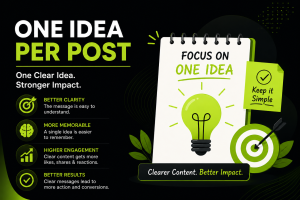
In today’s fast-paced digital environment, content is consumed quickly and often skimmed rather than read in detail. However, it has been observed that many posts attempt to communicate multiple ideas at once. As a result, the message becomes unclear and engagement is reduced.
Therefore, one simple yet powerful rule should be applied—one idea per post. When this principle is followed, content becomes clearer, more impactful, and easier to remember.
What Does “One Idea Per Post” Mean?
The concept refers to focusing each piece of content on a single, clear message. Instead of combining multiple points, one core idea is communicated effectively.
This ensures:
- Better clarity
- Improved readability
- Stronger audience understanding
As a result, content performance is enhanced.
Why One Idea Per Post Works
1. Clarity Is Improved
When one idea is presented, confusion is reduced. Th
e audience can quickly understand the message without effort.
Consequently:
- Communication becomes effective
- The message is retained longer
- Engagement improves
2. Content Becomes More Memorable
Multiple ideas can dilute the impact of a post. However, a single idea is easier to remember.
Therefore:
- Brand recall is strengthened
- Key messages stand out
3. Engagement Rates Increase
Clear and focused content is more likely to be read, liked, and shared. As a result, engagement improves significantly.
4. Decision-Making Is Simplified
When the message is clear, users can take action more easily. Consequently, conversions are more likely.
How to Apply the One Idea Rule
Step 1: Define the Core Message
Before creating content, one key takeaway should be identified. This ensures focus.
Step 2: Remove Unnecessary Information
Any content that does not support the main idea should
be eliminated. This improves clarity.
Step 3: Structure the Content Around One Point
Headings, examples, and explanations should all support the same idea.
Step 4: Add a Clear Call-to-Action
The CTA should align with the main message. This guides the audience toward a specific action.
Step 5: Keep It Simple
Simple language should be used to ensure easy understanding.
Common Mistakes to Avoid
1. Combining Multiple Messages
Trying to cover too many points in one post reduces effectiveness.
2. Overloading Information
Too much detail can overwhelm the audience.
3. Lack of Focus
Without a clear idea, content may feel scattered and confusing.
4. Weak Structure
Unstructured content makes it difficult for users to follow the message.
Supporting Benefits for SEO
- Improved readability
- Higher engagement signals
- Increased time spent on content
- Better audience retention
Consequently, search visibility and performance are enhanced.
Effective content is not about saying more—it is about saying the right thing clearly. It has been proven that focusing on one idea per post leads to better understanding, stronger engagement, and improved results.