
 Post by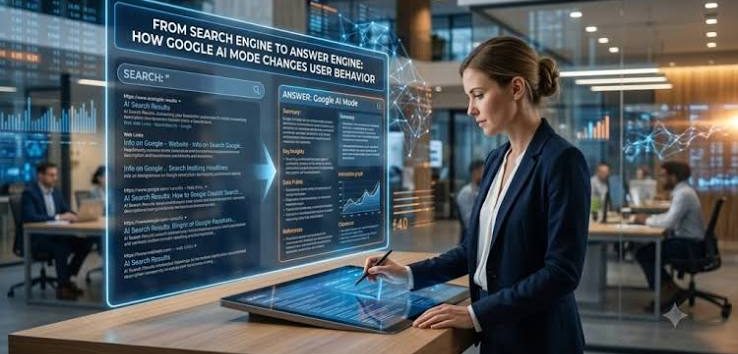
By Nandana G.S Digital Marketing Executive
For more than two decades, the internet has trained us to search, scan, click, and decide.
Type a query into Google.
Look through the results.
Open a few websites.
Compare the information.
Make a decision.
But search behaviour is changing.
Today, people can ask an AI-powered search engine a complete question, receive a summarized answer, ask follow-up questions, compare options, and continue their research without following the traditional “10 blue links” journey.
Search is no longer just about finding information.
It is increasingly about getting an answer.
And for businesses, this shift changes how digital visibility needs to be approached.
The Old Search Journey
The traditional search journey was relatively straightforward:
Search → Results → Website → Information → Decision
For example, someone looking for a digital marketing agency might search:
“Best digital marketing agencies in Kerala”
They would receive a list of websites, advertisements, maps, directories, and other results.
The user would then visit multiple websites, compare services, check reviews, and decide which company to contact.
For years, businesses optimized their websites around this behaviour.
They focused on:
Keywords
Rankings
Backlinks
Organic traffic
Click-through rates
Website conversions
These remain important.
But the journey is becoming more complex.
The New Search Journey
Now imagine the same person asking:
“I run a small business in Kerala. Which digital marketing services should I invest in if my goal is to build brand awareness and generate leads with a limited budget?”
This isn’t simply a keyword.
It’s a conversation.
The user has provided:
Context
Location
Business type
Goal
Budget consideration
Expected outcome
AI-powered search experiences are designed to understand this type of conversational and multi-part query.
Google has said that AI Overviews and AI Mode allow people to ask questions that are longer and more complex than traditional searches, with follow-up questions enabling deeper exploration.
That means the way people discover businesses is changing.
From Keywords to Questions
One of the biggest changes is the evolution of search queries.
Traditional search:
“HR consultancy Kochi”
Conversational search:
“What does an HR consultancy actually help a growing company with?”
More advanced search:
“My company has 50 employees and we’re struggling with payroll, documentation and compliance. What HR processes should we prioritize?”
The third query reveals much more about the user’s intent.
This is why businesses need to move beyond creating content around isolated keywords.
They need to understand the questions their customers are actually asking.
Search Is Becoming More Conversational
AI has changed our expectations of search.
Instead of thinking:
“What keyword should I type?”
people can now think:
“What do I want to know?”
That’s a major behavioural shift.
Users can:
Ask complete questions
Add context
Ask follow-up questions
Request comparisons
Refine their requirements
Ask for recommendations
Explore multiple possibilities
Continue a conversation
Google’s current Search experience is increasingly designed around this conversational model, with AI Overviews and AI Mode supporting follow-up exploration.
From “Where Can I Find It?” to “Just Tell Me”
Traditional search often required users to find the answer themselves.
For example:
Search:
“What is AEO?”
The user might open five different websites.
Read different explanations.
Compare them.
Then form their own understanding.
With an AI answer experience, the user may instead receive a synthesized explanation immediately, with links to sources for deeper research.
Google describes AI Overviews as providing a snapshot of key information with links for users who want to explore further.
The implication for businesses is important:
Your website isn’t only competing for clicks anymore.
Your information may also compete to become part of the answer.
The Rise of Zero-Click and Answer-Led Discovery
Another important change is what happens after the search.
Previously:
Search → Click → Website
Increasingly:
Search → AI Answer → Evaluate → Maybe Click
For simple questions, the user may get everything they need directly in the search experience.
For complex questions, they may continue to websites to investigate, verify information, compare providers, or make a purchase.
Google has reported that AI features are generating longer and more complex searches and says users continue clicking through when they want to explore further or take actions such as purchasing.
This creates a new challenge:
How do you make your brand valuable even before someone visits your website?
The Importance of Being Cited
In traditional SEO, businesses often ask:
“What position do we rank at?”
In AI search, another question becomes relevant:
“Is our content being used as a source?”
Microsoft’s Bing Webmaster Tools introduced an AI Performance report in 2026 that allows site owners to see how their content is cited in AI-generated answers across supported Microsoft experiences, including Copilot and AI-generated summaries in Bing.
This is an important signal of where search is heading.
Visibility isn’t only about appearing in a list.
It can also mean being referenced as evidence behind an answer.
What Does This Mean for Businesses?
Businesses need to rethink their content strategy.
A website should not simply say:
“We provide digital marketing services.”
It should answer questions such as:
What is digital marketing?
Which digital marketing strategy is right for a small business?
How much should a business invest in digital marketing?
How long does SEO take?
SEO vs paid advertising: which is better?
How can businesses generate leads through social media?
What should a startup do before launching digital marketing?
The more useful questions your content answers, the more opportunities you create to become part of your audience’s research journey.
Content Needs to Become More Answer-Friendly
The future isn’t necessarily about producing more content.
It’s about producing more useful content.
That means businesses should focus on:
Clear answers
Don’t make users search through 1,500 words to find a simple answer.
Strong structure
Use headings, subheadings, bullet points, tables, examples and FAQs.
Original insights
Generic content is easy to reproduce.
Experience-based insights are harder to replace.
Evidence
Support important claims with credible sources, data, examples and case studies.
Expertise
Show that real people understand the subject.
Freshness
Keep information updated when facts, products, services or industry conditions change.
Microsoft’s guidance around AI-generated answers emphasizes the importance of accurate, fresh, attributable information and clear evidence.
This Is Where AEO Comes In
This behavioural change connects directly with AEO — Answer Engine Optimization.
Traditional SEO asks:
“How can we help this page rank?”
AEO adds another question:
“How can we make this information clear, useful and relevant enough to become part of an answer?”
The objective isn’t to manipulate AI systems.
It is to make your business’s expertise easier to:
Discover → Understand → Trust → Reference
That’s why AEO should be considered an extension of a strong SEO and content strategy rather than a replacement for SEO.
Brand Authority Matters More Than Ever
There’s another important layer to this change:
AI can summarize information, but businesses still need to build trust.
Imagine two companies appearing in an AI-generated recommendation.
One has:
A basic website
Generic service descriptions
No case studies
Little online presence
Limited third-party information
The other has:
A strong website
Detailed service pages
Expert articles
Customer reviews
Case studies
Consistent brand information
Industry mentions
Useful educational content
Which brand is more likely to appear credible during the customer’s research process?
Digital authority matters.
Search visibility and brand visibility are increasingly connected.
The New Customer Journey
The customer journey is becoming less linear.
It may now look like:
AI Search
↓
Question
↓
AI-generated answer
↓
Brand discovery
↓
Website / Reviews / Social Media
↓
Comparison
↓
Trust
↓
Enquiry
↓
Purchase
This means businesses need to build a digital ecosystem rather than relying on a single webpage or keyword.
What Businesses Should Start Doing Now
1. Build a Question Bank
Ask your customers:
“What do you usually want to know before buying our service?”
Turn those questions into content.
2. Create Topic Clusters
Don’t publish one isolated article about a subject.
Build a collection of useful resources around it.
For example:
Digital Marketing
→ SEO
→ AEO
→ Social Media Marketing
→ Paid Advertising
→ Content Marketing
→ Lead Generation
→ Branding
→ Analytics
This creates a deeper content ecosystem.
3. Make Your Website Easy to Understand
Your website should clearly communicate:
Who you are
What you do
Who you serve
Where you operate
What makes you different
What proof you have
How people can contact you
Don’t make search engines—or customers—guess.
4. Invest in Original Content
AI can produce generic content at scale.
That makes generic content less valuable.
Your competitive advantage is increasingly:
Experience + Expertise + Evidence + Originality
Share:
Case studies
Results
Lessons learned
Industry insights
Expert opinions
Customer questions
Real examples
5. Track More Than Rankings
SEO reporting traditionally focuses on:
Keyword rankings
Organic traffic
Impressions
Clicks
Conversions
As AI search grows, businesses should also pay attention to:
AI citations
Brand mentions
AI visibility
Search-generated discovery
Branded searches
Referral quality
Content being referenced in answer experiences
The measurement landscape is still evolving, but tools such as Bing Webmaster Tools’ AI Performance report show that AI citation visibility is becoming measurable.
The Biggest Mistake Businesses Can Make
The biggest mistake isn’t failing to “optimize for AI.”
It’s ignoring the change in how customers discover information.
If your customers are asking more detailed questions, your content needs to answer those questions.
If customers are comparing businesses through AI, your digital presence needs to communicate credibility.
If search engines are increasingly generating answers, your information needs to be structured clearly enough to be understood and referenced.
Search Isn’t Disappearing. It’s Evolving.
Google isn’t disappearing.
SEO isn’t disappearing.
Websites aren’t disappearing.
The search experience is evolving.
The traditional search engine helped people find pages.
The emerging AI search experience can help people understand topics, compare options and navigate decisions.
Microsoft describes this evolution as a shift from traditional search systems that help users decide what to read toward AI grounding systems that help determine what to say, while still relying on web indexing as a foundation.
That distinction is important.
Because the future of digital marketing isn’t simply:
“How do I get found?”
It’s:
“How do I become useful enough to be part of the answer?”
The Future of Search Is the Future of Discovery
The brands that adapt early will not necessarily be the ones publishing the most content.
They will be the ones that understand their customers best.
They will know:
What people ask.
Why they ask it.
What information they need.
What makes them trust a business.
And most importantly:
How to become part of the conversation before the customer is ready to buy.
From Google Search to AI Answers, the fundamental shift is simple:
People are moving from searching for information to asking for understanding.
Businesses need to evolve with them.
LEVELUP DTS
Building brands for the next generation of digital discovery.