
 Post by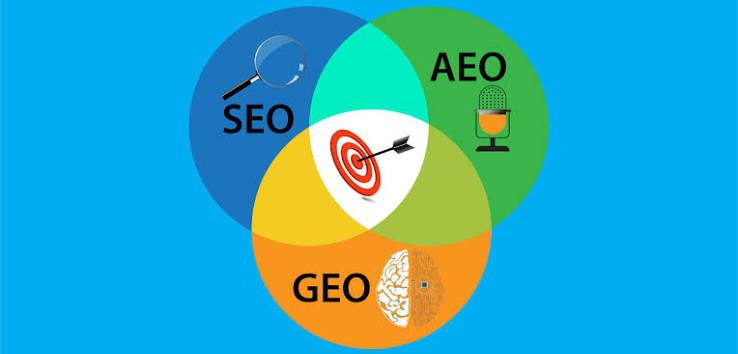
By Afla KC , Digital Marketing Executive
Introduction
For years, Search Engine Optimization (SEO) has been one of the most important digital marketing strategies for businesses.
Brands invested in keywords, backlinks, technical optimization, website content, and Google rankings to attract potential customers.
But search behaviour is changing.
People are no longer relying only on traditional search results. They are increasingly asking questions directly to AI-powered platforms, voice assistants, answer engines, and conversational search tools.
Instead of searching:
“Best digital marketing agency in Kochi”
a user may now ask an AI platform:
“Which digital marketing agencies in Kochi are suitable for a small business with a limited budget?”
The way people discover information is becoming more conversational, contextual, and answer-focused.
This shift is creating a new digital marketing landscape where SEO alone may not be enough.
In 2026, businesses need to think beyond search engine rankings and consider three interconnected strategies:
SEO – Search Engine Optimization
AEO – Answer Engine Optimization
GEO – Generative Engine Optimization
These strategies have different objectives, but together they can help brands improve their visibility across traditional search and AI-driven discovery.
What Is SEO?
SEO, or Search Engine Optimization, is the process of improving a website and its content so that search engines can understand, index, and rank it for relevant queries.
Traditional SEO focuses on improving visibility in search engine results.
Important SEO activities include:
- Keyword research
- Website optimization
- Technical SEO
- On-page SEO
- Content creation
- Internal linking
- Backlink building
- Mobile optimization
- Page speed
- Local SEO
For example, a company offering HR consulting services may create content around keywords such as:
“HR consultant in Kochi”
“HR outsourcing services”
“Payroll management services”
The objective is to appear when potential customers search for these terms.
SEO remains important in 2026.
The difference is that search is no longer limited to traditional blue-link results.
What Is AEO?
AEO stands for Answer Engine Optimization.
Instead of focusing only on ranking a webpage, AEO focuses on making content useful and understandable enough to be selected as an answer to a user’s specific question.
Answer engines aim to provide direct answers rather than simply presenting a list of websites.
For example, instead of searching:
“What is Professional Tax?”
a user may expect an immediate explanation.
Content that clearly answers common questions can have a better opportunity to appear in:
- Featured snippets
- Voice search results
- AI-generated answers
- Question-based search features
- Other answer-focused search experiences
AEO therefore encourages brands to structure content around real questions.
What Is GEO?
GEO stands for Generative Engine Optimization.
It refers to optimizing a brand’s online presence and content so that it has a better chance of being accurately represented, surfaced, or referenced by generative AI systems.
Generative search experiences can combine information from multiple sources and provide a conversational response.
For example, a user might ask:
“What should a small business consider before outsourcing payroll?”
Instead of receiving ten traditional search results, the user may receive an AI-generated explanation based on information gathered from multiple sources.
For businesses, this creates a new visibility challenge.
It is no longer enough to ask:
“Are we ranking on Google?”
Brands also need to ask:
“Is our business information clear, credible, useful, and discoverable across AI-driven search experiences?”
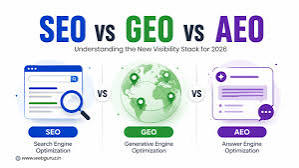
SEO vs AEO vs GEO
Although these strategies overlap, their primary goals are different.
StrategyMain FocusTypical GoalSEOSearch enginesImprove rankings and organic trafficAEOQuestions and answersIncrease visibility for direct answersGEOGenerative AI searchImprove brand visibility in AI-generated responses
The three should not be treated as competing strategies.
They work best together.
Why SEO Alone Is No Longer Enough
Traditional search is evolving from “search and click” toward “ask and receive.”
This doesn’t mean websites or Google rankings are becoming irrelevant.
Instead, the customer journey is becoming more complex.
A potential customer may discover a brand through:
- Google search
- AI-generated answers
- Voice search
- Social media
- YouTube
- Online reviews
- Business directories
- Community discussions
- Brand websites
This means businesses need a broader digital visibility strategy.
A company that focuses only on ranking keywords may miss opportunities to influence how AI systems understand its brand.
1. Search Queries Are Becoming More Conversational
Users increasingly search using complete questions rather than short keyword combinations.
Traditional search:
“Payroll services Kochi”
Conversational search:
“Which payroll services can help a growing company manage compliance and monthly salary processing?”
This means content should address the intent behind the search, not simply repeat keywords.
Brands need to understand what their audience actually wants to know.
2. Content Quality Matters More Than Keyword Density
Older SEO approaches often focused heavily on repeating target keywords.
Modern search requires a different approach.
Content should be:
- Useful
- Accurate
- Clear
- Relevant
- Well structured
- Easy to understand
- Written for real users
Instead of creating an article simply because a keyword has search volume, businesses should create content that genuinely answers customer questions.
For example, instead of publishing:
“Payroll Services – Payroll Services Company – Payroll Services Provider”
a better approach would be:
“How Payroll Outsourcing Can Reduce Administrative Work for Growing Businesses”
The second topic provides genuine value while naturally incorporating relevant search terms.
3. Brands Need Strong Topical Authority
One article is rarely enough to establish expertise around a subject.
Suppose a company wants to become known for payroll solutions.
It could create a content ecosystem covering:
- Payroll processing
- Payroll compliance
- Salary calculations
- Professional Tax
- TDS
- Employee deductions
- Payroll outsourcing
- Payroll errors
- Payroll software
- Payroll audits
This creates a network of related information.
Search engines and AI systems can better understand the organisation’s area of expertise when its online content consistently demonstrates knowledge of a particular subject.
4. AEO Requires Question-Based Content
AEO encourages brands to identify the questions their customers actually ask.
These questions can come from:
- Customer calls
- Sales teams
- FAQs
- Search suggestions
- Social media comments
- Customer support conversations
- Online communities
For example:
What is payroll outsourcing?
How much does payroll outsourcing cost?
Who should manage payroll in a small business?
How often should payroll be processed?
What payroll compliance requirements should employers know?
Answering these questions clearly can make content more useful across multiple search experiences.
5. GEO Makes Brand Authority More Important
Generative AI systems need reliable information to construct useful responses.
Brands should therefore maintain consistent and accurate information across their digital presence.
Important information includes:
- Company name
- Services
- Locations
- Expertise
- Industry focus
- Contact information
- Team information
- Products
- Customer reviews
- Case studies
- Authoritative content
If different websites contain conflicting information about a company, it can make the brand harder to understand.
Consistency matters.
6. Original Content Can Strengthen Digital Authority
AI can generate enormous amounts of generic content.
That makes original information more valuable.
Brands can differentiate themselves through:
- Original research
- Case studies
- Customer insights
- Expert opinions
- Industry analysis
- Data
- Examples
- Interviews
- Demonstrations
- First-hand experience
Instead of publishing content that simply repeats information already available online, businesses should add something meaningful to the conversation.
7. Local Businesses Need All Three
Local businesses should not think that SEO, AEO, and GEO are only relevant to large companies.
A local customer might ask:
“Who provides reliable HR consulting services near me?”
or:
“Which digital marketing agency is suitable for a small business in Kochi?”
Local visibility depends on accurate business information across the web.
Businesses should maintain:
- Google Business Profile
- Website
- Local landing pages
- Reviews
- Business directories
- Social profiles
- Consistent contact information
Local SEO remains an important part of the overall strategy, while question-based content and strong brand information can support visibility in AI-driven discovery.
8. Reviews and Reputation Matter
Digital visibility is not just about websites.
Customers increasingly evaluate brands through reviews and third-party information.
Businesses should actively build a trustworthy online reputation through:
- Genuine customer reviews
- Testimonials
- Case studies
- Professional profiles
- Industry mentions
- Relevant directory listings
- Consistent business information
A strong reputation can support both traditional search visibility and broader brand discovery.
9. Technical SEO Still Matters
The rise of AEO and GEO does not mean technical SEO can be ignored.
Search engines and AI-driven systems still need to access and understand websites.
Businesses should pay attention to:
- Website crawlability
- Indexing
- Page speed
- Mobile usability
- Structured data
- Internal links
- Clean website architecture
- HTTPS
- Canonicalisation
- Proper metadata
A technically weak website can limit the effectiveness of even excellent content.
10. Build Content for People First
The most effective approach to SEO, AEO, and GEO is surprisingly simple:
Create genuinely useful content for people.
Don’t write an article only because an AI tool suggested a keyword.
Start with the audience.
Ask:
- What problem are they facing?
- What question are they asking?
- What information do they need before making a decision?
- What could stop them from buying?
- What mistakes are they trying to avoid?
- What would make them trust this brand?
Then create content that provides useful answers.
How to Build an SEO + AEO + GEO Strategy
A practical strategy can follow these steps.
Step 1: Understand Your Audience
Identify your customer’s problems, questions, search behaviour, and decision-making process.
Step 2: Build Keyword and Question Lists
Combine traditional keywords with conversational questions.
Step 3: Create High-Quality Content
Develop blogs, guides, FAQs, videos, case studies, and service pages.
Step 4: Structure Content Clearly
Use:
- Clear headings
- Short paragraphs
- Lists
- Tables
- FAQs
- Direct answers
Step 5: Demonstrate Expertise
Use real examples, data, experience, and expert insights.
Step 6: Strengthen Your Website
Ensure that your technical SEO, site structure, and internal linking are strong.
Step 7: Maintain Consistent Brand Information
Keep company information accurate across your website, business profiles, directories, and other relevant platforms.
Step 8: Build Digital Authority
Earn quality mentions, reviews, backlinks, partnerships, and industry recognition.
Step 9: Monitor Search and Brand Visibility
Track not only rankings and traffic but also branded searches, conversions, referral sources, and how customers discover your business.
Metrics Businesses Should Track
Traditional SEO metrics remain valuable, including:
- Organic traffic
- Keyword rankings
- Click-through rate
- Backlinks
- Organic conversions
For a broader search strategy, businesses can also monitor:
- Featured snippet visibility
- Question-based search performance
- Branded search growth
- Direct traffic
- Referral traffic
- Leads from organic channels
- Engagement
- Conversion rate
- Brand mentions
The goal should not be simply to collect traffic.
The ultimate goal is to generate visibility, trust, leads, and business growth.
The Future of Search Is Multichannel
The biggest mistake brands can make is treating SEO, AEO, and GEO as completely separate marketing activities.
They are part of a larger shift in how people discover information.
A customer may:
Search → Read → Ask AI → Watch a Video → Check Reviews → Visit Website → Contact Brand
Every touchpoint creates an opportunity for the business to be discovered and trusted.
Therefore, the brands that succeed in 2026 and beyond will likely be those that build a strong and consistent digital presence across multiple discovery channels.
Conclusion
SEO is not dead.
It is evolving.
Traditional SEO remains essential for helping websites become discoverable through search engines. But as users increasingly interact with answer engines and generative AI, brands need to expand their approach.
SEO helps you get discovered.
AEO helps you become an answer.
GEO helps your brand become part of the AI-driven discovery experience.
The real opportunity is not choosing one over another.
It is building a digital strategy where all three work together.
Businesses should focus on creating useful content, answering real customer questions, demonstrating genuine expertise, maintaining accurate brand information, strengthening technical foundations, and building a trustworthy digital reputation.
The future of search is not simply about ranking #1.
It is about being visible, useful, credible, and trusted wherever your customers are looking for answers.
In 2026, brands should stop asking only, “How do we rank?” and start asking, “How do we become the brand people—and the systems helping them—can confidently find and trust?”