
 Post by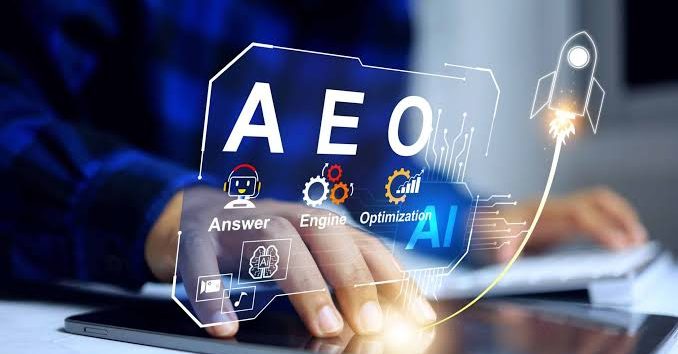
By Nandana G.S , Digital Marketing Executive
The future of search is not just about ranking. It’s about becoming the answer.
For years, businesses have been asking one question:
“How do we rank higher on Google?”
That question still matters.
But search is changing.
Today, people are increasingly asking questions directly to AI-powered search experiences and assistants instead of simply scrolling through pages of traditional search results.
They ask:
“What is the best digital marketing agency for startups?”
“Which HR consultancy can help with payroll compliance?”
“What should I consider before choosing a branding agency?”
“Which digital marketing strategy is best for a small business?”
And increasingly, they expect an answer, not just a list of websites.
This is where AEO — Answer Engine Optimization — becomes important.
What Is AEO?
Answer Engine Optimization (AEO) is the practice of creating and structuring digital content so that search engines, AI-powered search experiences, and answer engines can easily understand, extract, and present your information when users ask questions.
Traditional SEO focuses heavily on:
“How can I rank this page?”
AEO asks:
“How can I make this page the best possible answer to this question?”
That is a major shift in mindset.
Instead of creating content only around keywords, businesses need to create content around:
- Questions
- Search intent
- Clear answers
- Context
- Expertise
- Evidence
- Structured information
- Real-world usefulness
The goal isn’t simply to appear in search.
The goal is to become a trusted source that search and AI systems can reference.
SEO vs AEO: What’s the Difference?
SEO and AEO are not competitors.
They work together.
Traditional SEO
SEO generally focuses on improving a website’s visibility in search engines through:
- Keywords
- Technical optimization
- Website structure
- Backlinks
- Content quality
- Metadata
- Page experience
- Search intent
The traditional objective is:
Get discovered → Get ranked → Get clicked
AEO
AEO focuses more heavily on helping answer engines understand and retrieve your content when users ask specific questions.
The objective becomes:
Get discovered → Get understood → Get referenced → Become the answer
This doesn’t mean traditional SEO is becoming irrelevant.
In fact, Google’s current guidance for its generative search experiences emphasizes that established SEO fundamentals continue to matter.
Instead, businesses need to think beyond rankings.
Why Is AEO Becoming Important?
Because search behaviour is evolving.
The traditional search journey often looked like this:
Question → Google → Search Results → Website → Information
The emerging AI-assisted journey can look more like:
Question → AI/Search Experience → Synthesized Answer → Sources → Decision
That changes the role of your website.
Your website is no longer only a destination.
It can become a source of information that helps generate the answer itself.
Microsoft is already providing AI Performance insights in Bing Webmaster Tools that show publishers which pages are cited in AI-generated answers and the types of queries associated with those citations.
That is a significant signal:
AI visibility is becoming measurable.
AEO Is About Questions, Not Just Keywords
Consider two approaches.
Approach 1: Keyword-focused
A digital marketing agency might create a page targeting:
“Digital Marketing Agency Kerala”
Useful?
Yes.
But it may not answer all the questions a potential customer has.
Approach 2: Question-focused
The same agency could create content answering:
- What does a digital marketing agency do?
- How much does digital marketing cost?
- How long does SEO take to show results?
- What is the difference between SEO and AEO?
- How can businesses generate leads through digital marketing?
- What should startups look for in a digital marketing agency?
- Is social media marketing enough for a business?
- How does AI search affect digital marketing?
Now the brand is building a knowledge ecosystem around its expertise.
That’s where AEO becomes powerful.
What Makes Content AEO-Friendly?
There is no magic formula that guarantees that an AI system will cite a particular webpage.
However, businesses can make their content significantly easier to understand, retrieve and reference.
Here are some of the most important principles.
1. Answer the Question Directly
Don’t make users — or answer engines — search through 2,000 words before finding the actual answer.
If the heading is:
“What Is AEO?”
Start with a clear explanation.
For example:
AEO is the process of optimizing content so search engines and AI-powered answer systems can understand, retrieve and present that information in response to relevant user questions.
Then expand.
Answer first. Explanation second.
2. Build Content Around Search Intent
People don’t search randomly.
They have an intention.
A user might want to:
Learn
“What is AEO?”
Compare
“SEO vs AEO — what’s the difference?”
Evaluate
“Is AEO worth investing in?”
Buy
“Best AEO agency for my business”
Solve a problem
“How can I make my website visible in AI search?”
Your content strategy should address these different intents.
3. Use Question-Based Headings
Instead of creating vague headings such as:
“Our Approach to Digital Transformation”
consider adding useful question-led sections:
- What is digital transformation?
- Why does digital transformation matter?
- How much does digital transformation cost?
- What mistakes should businesses avoid?
- How can a business start?
Question-based structures make content easier for humans to scan and can also help answer systems identify the specific information each section addresses.
Bing’s current guidance specifically recommends clear headings, concise sections, tables and FAQ-style content when improving content for AI-generated answers.
4. Create Deep, Topically Relevant Content
One blog post shouldn’t have to answer everything.
Instead, build topic clusters.
For example:
Pillar Topic:
AEO: The Complete Guide
Then create supporting content:
- What is AEO?
- SEO vs AEO
- AEO vs GEO
- How AI search works
- How to optimize content for AI search
- How businesses can measure AI visibility
- Common AEO mistakes
- AEO strategy for local businesses
- AEO strategy for e-commerce
- AEO strategy for B2B companies
Together, these pages create a stronger topical ecosystem.
5. Demonstrate Expertise
AI systems need reliable information.
Businesses should therefore move beyond generic, recycled content.
Instead of saying:
“Social media is important for businesses.”
Explain:
- Why it matters
- When it matters
- Who benefits from it
- What strategy works
- What doesn’t work
- Real examples
- Data
- Industry-specific insights
- Practical recommendations
Generic content is easy to create.
Expert content is harder to replace.
And that’s exactly why it has greater long-term value.
6. Support Claims With Evidence
If you make an important claim, support it.
Use:
- Original research
- Statistics
- Case studies
- Industry reports
- First-party data
- Expert opinions
- Credible external sources
- Real examples
Bing’s guidance for AI visibility specifically highlights supporting claims with evidence and keeping information accurate and fresh.
The principle is simple:
Don’t just make claims. Build reasons to believe them.
7. Keep Your Content Fresh
AI-driven search experiences operate in a constantly changing information environment.
Outdated content can become less useful.
Imagine a blog published in 2022 saying:
“These are the latest trends in AI search.”
If nothing has been updated since then, can users trust it?
Probably not.
Businesses should regularly review important content for:
- Outdated statistics
- Old examples
- Broken links
- Changed technologies
- New industry developments
- Incorrect pricing
- Outdated processes
- New customer questions
Freshness isn’t about changing a publication date.
It’s about keeping the information genuinely useful and accurate.
8. Make Your Brand Easy to Understand
This is an underrated part of AEO.
AI systems need to understand who you are, what you do and what you are known for.
For example, a company shouldn’t have one website page describing itself as:
“A creative agency.”
Another page:
“A digital marketing company.”
Another:
“A branding studio.”
And another:
“A technology solutions provider.”
If your positioning is unclear, your digital presence becomes harder to interpret.
Your brand should have consistent information across:
- Website
- Google Business Profile
- Social media
- Business directories
- Author profiles
- Press mentions
- Videos
- Articles
Consistency builds clarity.
9. Think Beyond Text
AEO isn’t only about blogs.
Your digital knowledge can exist across:
Websites + Blogs + Videos + Podcasts + LinkedIn + FAQs + Case Studies + Reviews + Social Content
This is where AEO starts connecting with GEO — Generative Engine Optimization.
Microsoft describes GEO as understanding how content participates in AI-driven experiences, where visibility can involve answers, citations and outcomes rather than only traditional rankings and clicks.
So the future strategy isn’t:
“Write more blogs.”
It is:
“Build a stronger digital knowledge ecosystem.”
AEO + GEO + SEO: How Do They Fit Together?
Think of them as three connected layers.
SEO
Help search engines discover and rank your content.
↓
AEO
Help answer engines understand and retrieve your content.
↓
GEO
Build visibility within generative AI experiences and the broader AI-driven discovery ecosystem.
These aren’t completely separate disciplines.
They overlap.
A strong content strategy can support all three.
What Happens If Businesses Ignore AEO?
The biggest risk isn’t necessarily that your website suddenly disappears from Google.
The bigger risk is:
Your competitors become the sources that AI systems reference when customers ask questions about your industry.
Imagine someone asks:
“What are the best digital marketing strategies for a small business?”
Your competitor is repeatedly referenced.
You aren’t.
The customer may never discover you.
Not because your business is worse.
Not because your service is worse.
But because your digital knowledge wasn’t sufficiently visible or understandable in the answer ecosystem.
That is the strategic opportunity.
How Can a Business Start With AEO?
You don’t need to rebuild your entire website tomorrow.
Start with these steps.
Step 1: Identify Your Customer Questions
Talk to:
- Sales teams
- Customer support
- Business owners
- Existing customers
- Search data
- Social media comments
- Reviews
- FAQs
Create a list of real questions customers ask.
Step 2: Map Questions to Search Intent
Categorize them:
Informational
“What is…?”
Commercial
“Which is better…?”
Transactional
“How do I buy…?”
Problem-solving
“How can I fix…?”
Local
“Who provides… near me?”
Step 3: Build Content Around Those Questions
Create:
- Blog posts
- Service pages
- FAQs
- Comparison pages
- Guides
- Case studies
- Videos
- LinkedIn articles
- Short-form content
Step 4: Improve Content Structure
Use:
- Clear H1/H2/H3 headings
- Short paragraphs
- Direct answers
- Bullet points
- Tables where appropriate
- FAQs
- Definitions
- Examples
- Internal links
- Relevant structured data
Step 5: Strengthen Authority
Show:
Who created the content.
Why they are qualified.
What evidence supports the claim.
Where the information comes from.
What real-world experience backs it up.
Step 6: Measure AI Visibility
Traditional SEO metrics still matter:
- Rankings
- Impressions
- Clicks
- Organic traffic
- Conversions
But businesses should increasingly pay attention to AI-related signals such as:
- AI citations
- Referenced URLs
- AI-generated answer visibility
- Brand mentions
- Queries associated with citations
- Referral traffic where measurable
Bing’s AI Performance reporting now provides visibility into cited pages, citation activity and grounding queries across supported AI experiences.
AEO Is Not About “Gaming” AI
This is important.
AEO should not become another keyword-stuffing exercise.
Trying to manipulate AI systems with:
❌ Repetitive keywords ❌ Artificial FAQs ❌ Generic AI-generated content ❌ Fake expertise ❌ Unsupported claims ❌ Massive amounts of low-value content
is not a sustainable strategy.
The better approach is:
Create genuinely useful information that is easy for both humans and machines to understand.
In other words:
Don’t optimize only for the algorithm.
Optimize for the question.
The New Search Visibility Equation
The old mindset was:
Keywords → Rankings → Clicks → Traffic
The emerging mindset is broader:
Questions → Useful Content → Understanding → Retrieval → Citations → Trust → Action
And this changes what businesses should invest in.
Your website shouldn’t simply say:
“We provide digital marketing services.”
It should answer:
What do you do?
Who do you help?
What problems do you solve?
How do you solve them?
Why should customers trust you?
How much does it cost?
What makes you different?
What results have you achieved?
What questions do your customers ask before buying?
That is where modern content strategy begins.
The Future of Search Belongs to Brands That Answer Better
Search is moving from:
“Find me a website.”
towards:
“Give me the best answer.”
Businesses that understand this shift can start building their digital presence accordingly.
SEO will still matter.
Content will still matter.
Websites will still matter.
But the definition of visibility is expanding.
Being on page one is valuable.
Being the source behind the answer can be even more powerful.
The brands that win in the AI-first search era will not necessarily be the brands that publish the most content.
They will be the brands that consistently provide:
Clear answers. Useful information. Strong expertise. Reliable evidence. Consistent brand signals. And genuine value.
Final Thought
AEO isn’t simply another digital marketing acronym.
It represents a broader change in how people discover information.
The question businesses should start asking isn’t only:
“Are we ranking on Google?”
It should also be:
“When our customers ask AI about our industry, are we part of the answer?”
Because in the next phase of digital discovery,
Visibility won’t just mean being found.
It will mean being understood, trusted and referenced.
At LEVELUP DTS, We Believe the Future of Digital Growth Is AI-First.
From SEO and AEO to GEO, content strategy, branding and digital visibility, businesses need a connected strategy — not isolated marketing activities.
Don’t just compete for rankings.
Build a brand worth finding — and a source worth citing.
LEVELUP DTS
Build. Position. Grow.