
 Post by
 By Afla KC , Digital Marketing executive
Introduction
“Just post consistently.”
It’s one of the most common pieces of advice businesses hear about content marketing.
Create a few Instagram posts. Publish some Reels. Write blogs. Share company updates. Follow trends. Keep the page active.
But there is a problem.
Content creation is not the same as content strategy.
A business can publish every day and still struggle to generate leads, build brand recognition, or increase sales.
Why?
Because having more content doesn’t automatically mean having better marketing.
Content becomes valuable when it has a clear purpose.
It should help a business achieve something—whether that’s increasing awareness, building trust, educating customers, generating leads, supporting sales, or creating long-term brand authority.
In a crowded digital environment, brands don’t need to simply create more content.
They need to create content that moves people closer to a business goal.
What Is the Difference Between Content and Content Strategy?
Content is the actual material you publish.
That could be:
A Reel
A blog
An Instagram post
A YouTube video
A LinkedIn article
An email
A case study
A customer testimonial
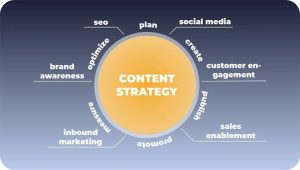
Content strategy is the thinking behind that content.
It answers questions such as:
Who are we creating this for?
Why are we creating it?
What should the audience learn or feel?
What business goal does it support?
Where will it be published?
What action should the audience take?
Without this thinking, businesses can end up producing content simply because they feel they need to post something.
That’s not strategy.That’s activity.
.
1. Start With a Business Goal
The first step in building a content strategy is understanding what the business actually wants to achieve.
Different businesses have different goals.
For example:
A New Brand
May want to build awareness and recognition.
A Service Business
May want to generate qualified enquiries.
An E-commerce Brand
May focus on product discovery and sales.
A B2B Company
May focus on authority, trust, and lead generation.
An Established Brand
May focus on customer loyalty and market leadership.
Your content strategy should reflect these goals.
Instead of asking:
“What should we post today?”
ask:
“What business objective should our content support this month?”
That simple change can completely improve content planning.
2. Know Who You’re Talking To
Good content starts with understanding the audience.
Your customers aren’t simply demographics.
You need to understand:
What problems they have
What questions they ask
What they care about
What prevents them from buying
What alternatives they consider
What motivates them
What information they need before making a decision
For example, a business selling accounting software shouldn’t create the same content for a freelancer and a large enterprise.
Their challenges are different.
Their decision-making process is different.
Their expectations are different.
The better you understand the audience, the more relevant your content becomes.
3. Define Your Content Pillars
One of the easiest ways to make content more strategic is to establish content pillars.
Content pillars are the core topics your brand consistently communicates about.
For example, a digital solutions company might use:
Education
Explain digital tools, automation, SEO, AI, and business technology.
Expertise
Share industry insights, frameworks, and professional opinions.
Case Studies
Show how solutions have helped real businesses.
Brand
Show people, culture, values, and behind-the-scenes moments.
Conversion
Explain services, offers, solutions, and next steps.
These pillars prevent your content calendar from becoming random.
4. Create Content for Different Stages of the Customer Journey
Not every customer is ready to buy today.
Some people have just discovered your brand.
Others are actively comparing solutions.
Some are already customers.
Your content should reflect these different stages.
Awareness
The customer is discovering a problem.
Create:
Educational Reels
Informational posts
Industry insights
Short videos
Beginner guides
Consideration
The customer is researching solutions.
Create:
Comparisons
Case studies
Demonstrations
FAQs
Detailed guides
Decision
The customer is ready to take action.
Create:
Testimonials
Product demonstrations
Pricing information
Service explanations
Consultation offers
Retention
The customer has already purchased.
Create:
Tutorials
Support content
Customer stories
Product updates
Loyalty content
This creates a more complete content ecosystem.
5. Stop Making Everything About Selling
One of the fastest ways to make content boring is to turn every post into an advertisement.
Buy now.
Contact us.
Limited offer.
Book today.
Promotional content has a place.
But if every interaction asks for a sale, audiences may stop paying attention.
A strong content strategy balances:
Education + Entertainment + Inspiration + Trust + Promotion
Not every piece of content needs to convert immediately.
Some content exists to build familiarity.
Some builds authority.
Some answers questions.
Some strengthens the brand.
Together, they contribute to the customer journey.
6. Solve Problems Through Content
One of the best content strategies is simple:
Answer the questions your customers are already asking.
Think about:
What do customers ask your sales team?
What questions come up repeatedly?
What causes customers confusion?
What mistakes do they make?
What information do they need before buying?
Turn those questions into content.
For example:
If customers repeatedly ask:
“How much does SEO cost?”
create a useful article explaining the factors that influence SEO pricing.
If customers ask:
“Should I choose Google Ads or Meta Ads?”
create a comparison.
Your customers are already giving you your content topics.
You just need to listen.
7. Build Content Around Expertise
Content should demonstrate why your business deserves attention.
Don’t simply say:
“We are experts.”
Show it.
Share:
Industry insights
Practical frameworks
Data
Case studies
Lessons learned
Analysis
Opinions
Real examples
Expertise becomes more believable when audiences can experience it through your content.
This is especially important for professional services and B2B brands.
8. Use Storytelling to Make Content Memorable
Information can educate.
Stories can make people care.
Instead of simply explaining what your company does, show:
How the business started
Problems you solved
Customer journeys
Behind-the-scenes experiences
Failures and lessons
Team stories
Product development
For example:
Instead of:
“Our software saves businesses time.”
tell the story of a business that was spending hours every week on manual processes and how automation changed its workflow.
The second approach gives the audience something to imagine.
9. Create Content for the Platform
A common mistake is creating one piece of content and copying it everywhere.
Different platforms have different user behaviours.
Visual, quick, emotional, and highly engaging.
Professional, educational, analytical, and opinion-driven.
YouTube
Suitable for deeper explanations, demonstrations, and storytelling.
Website
Ideal for detailed information, SEO, conversions, and resources.
The core message can remain consistent.
But the format should adapt to the platform.
10. Repurpose Instead of Constantly Starting From Zero
Content strategy doesn’t mean creating something completely new every day.
One strong idea can become multiple pieces of content.
For example, a detailed blog about business automation could become:
3 Instagram Reels
1 LinkedIn post
5 carousel ideas
1 infographic
1 email
3 short video clips
A customer FAQ
This approach makes content production more efficient.
The goal is not to repeat the exact same content.
It’s to extract more value from strong ideas.
11. Build Content That Supports Sales
Marketing and sales shouldn’t operate separately.
Your content can help answer the questions that sales teams hear every day.
For example:
“Why should we choose you?”
Create comparison content.
“Can your service solve our specific problem?”
Create a case study.
“How does the process work?”
Create an explainer video.
“What results can we expect?”
Create a realistic results-focused guide.
This reduces uncertainty.
Good content doesn’t replace sales.
It makes the sales conversation easier.
12. Use Social Proof
People naturally look for evidence before making decisions.
That’s why social proof is powerful.
Content can include:
Testimonials
Reviews
Case studies
Before-and-after examples
Customer stories
Results
User-generated content
Instead of constantly saying:
“We’re great.”
let your customers demonstrate the value.
13. Don’t Chase Every Trend
Trends can generate attention.
But attention isn’t always the same as business value.
A brand shouldn’t participate in every trend simply because it is popular.
Before using a trend, ask:
Does it fit our audience?
Does it fit our brand?
Does it support our positioning?
Can we connect it naturally to our business?
If the answer is no, skipping the trend may be the smarter strategy.
14. Create Content With a Clear CTA
Not every piece of content needs a sales CTA.
But the audience should know what to do next when appropriate.
Depending on the objective, your CTA could be:
Learn more
Read the full guide
Save this post
Share with your team
Download the resource
Book a consultation
Request a demo
The CTA should match the content and the audience’s stage in the customer journey.
15. Measure Business Impact, Not Just Likes
Likes can be useful.
But they don’t tell the complete story.
A business should also monitor:
Website traffic
Leads
Enquiries
Sales
Conversion rate
Search visibility
Email sign-ups
Content engagement
Qualified traffic
Customer acquisition
For example, a post with 200 likes may generate no business.
Another post with 30 likes may generate five qualified enquiries.
Which one performed better?
It depends on the business objective.
That’s why content performance should be evaluated against purpose, not vanity metrics alone.
16. Give Your Strategy Time to Work
Content marketing is often a long-term game.
A single post may not transform a business.
But consistent, relevant content can gradually build:
Awareness
Trust
Expertise
Search visibility
Community
Brand recognition
Customer loyalty
The goal is to create a library of valuable content that continues working for the business.
A good blog can attract search traffic months after publication.
A useful video can continue generating views.
A strong case study can influence future buyers.
This is the compounding value of strategic content.
A Simple Content Strategy Framework
Businesses can use this framework when planning content:
1. Goal
What business result are we trying to support?
2. Audience
Who are we speaking to?
3. Problem
What problem or question do they have?
4. Message
What do we want them to understand?
5. Format
What is the best format for communicating it?
6. Platform
Where does this audience consume content?
7. CTA
What should they do next?
8. Measurement
How will we know whether it worked?
This turns content creation into a structured process.
What Strategic Content Looks Like
Imagine a digital solutions company wants to generate leads for business automation.
Instead of publishing random posts such as:
“Automation is the future.”
“Contact us for solutions.”
“Happy Monday!”
It could build a strategic content series:
Problem: Businesses lose time on repetitive work.
Education: Identify processes that can be automated.
Value: Explain the benefits.
Proof: Show a case study.
Objection: Address common concerns.
Comparison: Manual vs automated workflows.
Conversion: Offer an automation consultation.
Now the content works together.
It isn’t just a collection of posts.
It is a marketing system.
The Future of Content Marketing
As AI makes content creation faster, the amount of content online will continue to increase.
This creates a new challenge.
If everyone can produce content quickly, simply producing more content will not create differentiation.
Brands will need:
Better ideas
Stronger opinions
Original insights
Authentic stories
Clear positioning
Deeper expertise
Better customer understanding
AI can help businesses generate drafts, ideas, formats, and variations.
But strategy still determines what should be created and why.
The future belongs to brands that combine technology with human understanding.
Conclusion
Content is everywhere.
But strategic content is much harder to find.
Businesses don’t need to publish simply because their competitors are posting.
They need to understand what they want their content to achieve.
A strong content strategy connects:
Business goals + Audience needs + Brand positioning + Valuable content + Distribution + Measurement
When these elements work together, content becomes more than something that fills a social media calendar.
It becomes a business asset.
It can attract the right audience, demonstrate expertise, build trust, support sales, improve search visibility, and strengthen long-term brand recognition.
So before creating your next post, Reel, blog, or video, don’t ask:
“What should we post today?”
Ask:
“Why are we creating this—and how does it help our audience and our business?”
Because content without a strategy is just activity.
Content with a clear purpose can become growth.