
 Post by
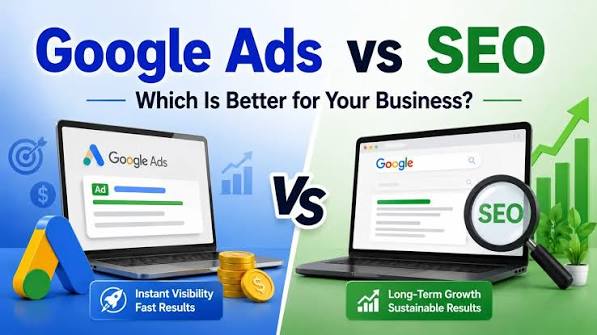
Every business wants more customers, better online visibility and consistent growth. But when it comes to digital marketing, one common question businesses face is: Should you invest in SEO or Google Ads?
Both strategies help businesses reach potential customers through Google. However, they work differently.
SEO focuses on improving your website’s visibility in organic search results, while Google Ads helps your business appear in paid advertising placements when people search for relevant products or services.
So, which one should your business choose?
The answer depends on your marketing goals, budget, competition and how quickly you want to generate enquiries.
Let’s understand the difference.
What Is SEO?
SEO stands for Search Engine Optimisation. It is the process of improving your website so that it can appear in relevant organic search results on Google.
For example, if someone searches for “best interior designers in Kochi”, businesses with well-optimised websites and relevant content may appear in the organic results.
SEO helps businesses attract people who are already searching for their products or services.
Important SEO Activities
Keyword research
On-page SEO
Technical SEO
Website optimisation
Content creation
Local SEO
Google Business Profile optimisation
Internal linking
Quality backlink development
Website performance improvement
Benefits of SEO
1. Long-Term Online Visibility
SEO helps businesses build organic visibility over time. Well-performing pages can continue attracting relevant visitors without paying for every click.
2. Builds Brand Credibility
Appearing in relevant organic search results can help businesses build familiarity and credibility with potential customers.
3. Attracts Relevant Traffic
By targeting the right keywords, businesses can reach people actively looking for specific products, services or information.
4. Supports Long-Term Growth
SEO creates a foundation for sustainable online visibility through website improvements, useful content and consistent optimisation.
5. Helps Local Businesses
Local SEO can help businesses improve their visibility when people search for nearby services.
However, SEO takes time and requires continuous effort. Rankings are not guaranteed, and results depend on competition, website quality and many other factors.
What Are Google Ads?
Google Ads is Google’s online advertising platform that allows businesses to display paid advertisements across Google Search and other advertising placements.
For example, when someone searches for “digital marketing agency in Kochi”, relevant businesses running Google Search campaigns may appear in sponsored positions.
Businesses can target relevant keywords, locations and audiences based on their campaign objectives.
Google Search Ads commonly use a pay-per-click model, meaning advertisers generally pay when someone clicks their advertisement.
Important Google Ads Activities
Keyword selection
Search campaign creation
Audience and location targeting
Ad copywriting
Budget management
Bid optimisation
Landing page optimisation
Conversion tracking
Remarketing
Campaign performance analysis
Benefits of Google Ads
1. Faster Visibility
Once a campaign is approved and running, your business can start appearing for relevant searches without waiting for organic rankings to improve.
2. Targeted Advertising
Businesses can target specific locations, search terms and other campaign settings to reach relevant audiences.
3. Budget Control
You can set campaign budgets, adjust bids and pause campaigns based on performance and business requirements.
4. Measurable Performance
Google Ads provides information about impressions, clicks, costs and conversions, helping businesses evaluate campaign performance.
5. Useful for Lead Generation
Businesses offering services such as real estate, education, healthcare and professional consulting can use search campaigns to reach people actively looking for solutions.
However, Google Ads requires an ongoing advertising budget. When campaigns stop running, the paid visibility generated by those campaigns also stops.
SEO vs Google Ads: Key Differences
Although both strategies help businesses reach customers through Google, their approach is different.
FactorSEOGoogle AdsMarketing typeOrganicPaidVisibilityBuilds over timeCan begin quicklyCostSEO service and implementation costsAd spend + management costsTrafficOrganic search trafficPaid campaign trafficLong-term valueBuilds organic visibilityRequires continued advertisingTargetingBased on search relevance and organic rankingKeyword, location and campaign targetingResultsUsually gradualFaster campaign visibilityBest forLong-term growthImmediate visibility and lead generationBudgetInvestment in ongoing optimisationFlexible advertising budget
Neither strategy is automatically better. Each serves a different purpose in a business’s digital marketing plan.
SEO vs Google Ads: Which Gives Faster Results?
If your business needs visibility quickly, Google Ads is generally the faster option.
For example, imagine a new real estate company launching a residential project in Kochi.
The company wants to attract potential buyers within the next few weeks.
Waiting for its website to rank organically for competitive property-related keywords may not be practical.
Google Ads can help the company reach people searching for relevant properties while its SEO strategy develops.
On the other hand, SEO can help the same company build long-term visibility through property-related content, location pages and useful website information.
Google Ads helps generate visibility faster. SEO helps build organic visibility over time.
Which Is More Cost-Effective: SEO or Google Ads?
This depends on the business and its marketing goals.
Google Ads requires a continuous advertising budget. The cost of clicks can vary depending on keyword competition, industry, location and campaign quality.
SEO does not involve paying Google for organic clicks. However, businesses still invest in SEO professionals, content creation, website development and ongoing optimisation.
For example:
A business with a limited advertising budget may prioritise local SEO and useful website content.
A business launching a new service may use Google Ads to generate early visibility.
A business operating in a competitive market may need both strategies.
The important factor is not simply how much traffic each channel generates.
It is how effectively that traffic converts into enquiries, customers and revenue.
When Should Your Business Choose SEO?
SEO may be the right starting point if your business:
Wants consistent organic website traffic.
Is focused on long-term digital growth.
Wants to improve visibility for industry-related keywords.
Wants to attract customers through Google searches.
Needs stronger local search visibility.
Wants to build authority through useful website content.
For example, a consultancy in Kochi can create service pages and informative blogs targeting relevant searches. Over time, these pages may help attract people looking for its services.
SEO is particularly useful when your business wants to establish a long-term digital presence.
When Should Your Business Choose Google Ads?
Google Ads may be more suitable if your business:
Needs enquiries within a shorter timeframe.
Is launching a new product or service.
Wants to promote a limited-period offer.
Needs targeted local visibility.
Wants to test demand for a particular service.
Has a defined advertising budget.
Wants to reach people actively searching for its products.
For example, an educational consultancy promoting an upcoming admission intake can use Google Ads to reach students searching for relevant courses and study opportunities.
The campaign can be adjusted based on enquiry quality and performance.
Why Businesses Should Consider Both SEO and Google Ads
Instead of treating SEO and Google Ads as competing strategies, businesses can use them together.
An integrated approach helps businesses generate short-term visibility while building long-term organic growth.
Consider this example:
A digital marketing agency in Kochi wants to attract more business enquiries.
Its strategy could include:
Google Ads
Target searches related to digital marketing services.
Generate relevant enquiries.
Test high-intent keywords.
Track cost per lead.
SEO
Optimise service pages.
Publish informative blogs.
Improve local search visibility.
Build relevant organic traffic.
Strengthen website authority.
Both channels can support different stages of the customer’s buying journey.
Google Ads can also provide useful keyword and conversion data that helps businesses understand which search terms are worth targeting through SEO. However, running ads does not directly improve organic rankings.
SEO and Google Ads Strategy for Small Businesses
Small businesses do not always have the budget to invest heavily in every marketing channel.
The best approach is to prioritise based on business requirements.
Business TypeRecommended ApproachNew startupBasic SEO + targeted Google AdsLocal service businessLocal SEO + Search AdsReal estate companySEO + lead-focused Google AdsEducational consultancySEO + admission campaign AdsE-commerce businessSEO + relevant paid campaignsEstablished companyIntegrated SEO and Google Ads
These are general starting points. The final strategy should depend on the business’s audience, competition, website readiness and available budget.
Common Mistakes Businesses Should Avoid
1. Expecting Immediate SEO Results
SEO requires time, consistent optimisation and useful content. Businesses should not expect guaranteed first-page rankings within a few days.
2. Running Google Ads Without a Clear Goal
Every campaign should have a defined objective, whether it is calls, enquiries, purchases or website visits.
3. Ignoring Landing Pages
Even a well-managed campaign may perform poorly if visitors reach a confusing or poorly designed website.
4. Targeting the Wrong Keywords
Irrelevant keywords can attract visitors who are unlikely to become customers.
5. Measuring Only Clicks
Clicks and impressions are not the same as business growth. Track qualified leads, conversions, sales and acquisition costs.
6. Ignoring Follow-Ups
Generating enquiries is only the first step. Businesses also need a proper system to respond to potential customers.
How to Measure the Performance of SEO and Google Ads
A successful digital marketing strategy should be measured through meaningful business metrics.
SEO Metrics:
Organic website traffic
Keyword visibility
Search impressions
Organic clicks
Website engagement
Organic leads
Organic conversions
Google Ads Metrics:
Impressions
Clicks
Click-through rate
Cost per click
Cost per lead
Conversion rate
Return on ad spend
Businesses should also measure lead quality and actual sales. A campaign that generates fewer but more relevant enquiries may deliver better business value than one generating a large number of unqualified leads.
How Level Up Digital Solutions Helps Businesses Grow
Level Up Digital Solutions helps businesses strengthen their online presence through digital marketing strategies that connect visibility with business objectives.
Our services include:
Search Engine Optimisation (SEO)
Google Ads Management
Meta Ads Management
Social Media Marketing
Content Creation
Video Production
Website Development
Branding and Creative Design
Digital Marketing Strategy
The focus is on understanding each business, identifying its target audience and selecting the right combination of marketing activities.
Whether a business needs better organic visibility, targeted advertising or a complete digital marketing strategy, the objective is to create a structured approach to growth.
Final Thoughts: SEO or Google Ads – Which Is Better?
So, SEO vs Google Ads: Which is better for your business?
If your priority is faster visibility and targeted advertising, Google Ads can be a suitable choice.
If your goal is long-term organic visibility, website authority and sustainable traffic, SEO is an important investment.
But for many businesses, the strongest strategy is to combine both.
Use Google Ads to reach potential customers when they are actively searching. Build SEO to strengthen your online presence for the future.
Don’t choose a marketing channel just because it is popular. Choose the strategy that supports your business goals.
SEO Keywords
Primary Keyword:
SEO vs Google Ads
Secondary Keywords:
SEO vs Google Ads for business
Difference between SEO and Google Ads
SEO or Google Ads which is better
SEO services for businesses
Google Ads management
SEO and PPC marketing
Digital marketing strategy
Google Ads vs organic search
SEO agency in Kochi
Google Ads agency in Kochi