
 Post by
By Afla KC , Digital Marketing Executive
Video has become one of the most important communication tools for modern businesses.
Companies use videos to introduce their brand, explain their services, showcase products, build trust, recruit employees, communicate with customers, and promote their business on social media.
But not every business video serves the same purpose.
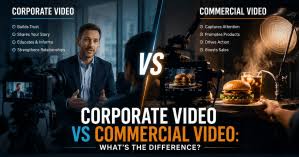
A corporate video and a social media video may both represent the same company, but they are created for very different viewing environments.
A corporate video may be designed to communicate the company’s story, capabilities, and professional image in a detailed way. A social media video usually needs to capture attention quickly and communicate one clear idea within a short period.
Understanding this difference can help businesses choose the right format, production style, and distribution strategy.
What Is a Corporate Video?
A corporate video is a professionally produced video created to communicate important information about a company, organisation, product, service, or internal initiative.
Corporate videos are commonly used for:
Company introductions
Brand films
Service presentations
Corporate profiles
Product demonstrations
Recruitment
Training
Internal communication
Investor or stakeholder presentations
Events and exhibitions
The primary objective is usually clear and professional communication.
A corporate video may run for several minutes because the audience is often intentionally watching it to understand the company or its offering.
For example, a manufacturing company might create a corporate video showing:
Company history
Manufacturing facility
Production process
Technology
Team
Quality standards
Products
Future vision
The video can provide a complete picture of the organisation.
What Is a Social Media Video?
A social media video is created specifically for platforms such as Instagram, Facebook, YouTube, LinkedIn, or other social channels.
The audience is usually scrolling through a feed, so the video needs to compete with many other pieces of content.
Social media videos can include:
Reels
Short-form videos
Product videos
Educational videos
Explainers
Customer testimonials
Behind-the-scenes videos
Founder videos
Trend-based content
Promotional videos
Short advertisements
The primary objective is often to capture attention quickly and encourage an action such as watching, engaging, visiting a profile, sending a message, or making an enquiry.
Corporate Video vs Social Media Video
The biggest difference is not simply video length.
It is the purpose, audience, viewing environment, and communication style.
FactorCorporate VideoSocial Media VideoMain purposeCommunicate company or business informationCapture attention and drive engagementAudienceCustomers, clients, partners, employees, stakeholdersSocial media users and potential customersViewing behaviourOften intentional viewingOften viewed while scrollingLengthCan be longerUsually shorterStyleStructured and polishedFast, engaging, platform-friendlyStorytellingDetailedFocused on one clear ideaProductionOften higher production focusCan range from simple to highly producedFormatOften landscapeOften verticalCTAInformational or business-focusedEngagement, enquiry, visit, purchase, etc.DistributionWebsite, presentations, events, YouTubeInstagram, Facebook, YouTube Shorts, LinkedIn, etc.
1. The Audience Is Different
The first major difference is the audience’s mindset.
Someone watching a corporate video on a company’s website may already be interested in the business.
They may want to understand:
Who is this company?
What does it do?
What services does it provide?
Can I trust this company?
Social media audiences behave differently.
They may not have any intention of learning about your business when they open Instagram.
Your video appears while they are scrolling.
That means the opening seconds become extremely important.
2. The Opening Is More Critical in Social Media Videos
A corporate video can gradually introduce the company.
A social media video usually cannot afford a long introduction.
For example, a corporate video might begin with:
“Established in 2010, our company has grown into a leading provider of…”
A social media video may instead begin with:
“Your business is getting views—but why aren’t you getting enquiries?”
The second approach immediately creates curiosity.
This is why social media videos often use:
Strong hooks
Questions
Surprising facts
Problems
Bold statements
Visual movement
Text overlays
The first few seconds need to give the viewer a reason to continue watching.
3. Length and Attention Span
Corporate videos are generally allowed more time to explain a subject.
A company profile might take several minutes because the viewer has a specific reason to watch it.
Social media videos often need to communicate their main idea much faster.
This doesn’t mean every social media video must be extremely short.
A useful principle is:
Use the length required to communicate the idea—without adding unnecessary information.
A 20-second video can be more effective than a 60-second video if it communicates the message clearly.
Similarly, a longer video can work when the story or subject justifies the additional viewing time.
4. Storytelling Approach
Corporate videos often tell a broader story.
For example:
Company → History → Team → Services → Process → Achievements → Vision
Social media videos generally focus on one specific idea.
For example:
Problem → Insight → Solution → CTA
or:
Hook → Story → Takeaway
This makes social media content easier to consume and allows businesses to create multiple videos from a larger topic.
A single corporate shoot could potentially produce:
One company profile video
Several service videos
Multiple Reels
Behind-the-scenes clips
Founder videos
Short educational videos
Testimonial clips
This is where content repurposing becomes valuable.
5. Production Style
Corporate videos traditionally place a strong emphasis on:
Professional cinematography
Lighting
Interviews
Corporate visuals
Voiceovers
Brand graphics
Structured editing
Professional music
Social media videos can use professional production too, but they often prioritise speed, relatability, and platform-native presentation.
A social media video might include:
Handheld footage
Talking-head videos
Quick cuts
Captions
Screen recordings
User-generated content
Trending formats
Simple animations
The production quality should still match the brand.
The difference is that social content often prioritises communication speed over formal presentation.
6. Video Format and Screen Orientation
The viewing environment also influences the format.
Corporate videos are often created in landscape formats because they may appear on:
Websites
Presentations
YouTube
Conference screens
Events
Large displays
Social media content, particularly short-form content, is commonly designed vertically for mobile viewing.
For example:
Corporate: 16:9 landscape
Social Media: 9:16 vertical
However, modern content production should consider multiple formats from the beginning.
A well-planned shoot can capture footage that can later be adapted for different platforms.
7. Corporate Videos Build Professional Perception
Corporate videos are particularly useful when a business needs to communicate credibility and scale.
For example, a company may use a corporate video during:
Business meetings
Client presentations
Exhibitions
Conferences
Website visits
Recruitment campaigns
Investor communication
A professionally produced video can help communicate the company’s:
Capabilities
Infrastructure
Expertise
Team
Processes
Brand story
It becomes part of the company’s larger communication system.
8. Social Media Videos Build Regular Engagement
Social media requires consistent communication.
A business cannot depend on one corporate video to maintain its digital presence.
Social media videos allow businesses to continuously communicate with their audience.
For example, a company could publish:
Monday: Educational Reel
Wednesday: Behind-the-scenes video
Friday: Customer testimonial
Sunday: Product/service video
This creates an ongoing relationship with the audience.
The objective is not necessarily to make every video a major production.
Consistency and relevance are often more important.
9. Corporate Video vs Social Media Video: When Should You Use Each?
Use a Corporate Video When You Need To:
Introduce your company
Explain your complete business
Present your capabilities
Build corporate credibility
Communicate with stakeholders
Support presentations
Showcase facilities
Create a long-term brand asset
Use Social Media Videos When You Need To:
Reach new audiences
Increase engagement
Explain specific topics
Promote products or services
Generate enquiries
Share customer stories
Build brand personality
Maintain consistent communication
In many cases, businesses need both.
They serve different roles in the marketing ecosystem.
10. One Corporate Video Can Become Multiple Social Media Videos
Businesses don’t necessarily have to choose between the two.
A smarter production strategy is to create content with repurposing in mind.
Imagine a company is producing a five-minute corporate film.
During the same production, the team could capture:
Main Corporate Film
A complete overview of the business.
Founder Reel
A short founder story.
Service Reels
Individual videos explaining specific services.
Team Content
Short employee introductions.
Behind-the-Scenes
Footage from the production day.
Testimonial Clips
Short customer experiences.
Educational Clips
Experts explaining common customer questions.
This turns one production project into a complete content library.
The Best Approach: Build a Video Content System
Instead of treating corporate videos and social media videos as completely separate activities, businesses can connect them.
A simple structure could be:
Brand Film
↓
Service Videos
↓
Expert Videos
↓
Customer Testimonials
↓
Educational Reels
↓
Behind-the-Scenes Content
↓
Short Promotional Videos
This creates consistency across the entire customer journey.
A customer may first discover your business through a Reel and later watch your corporate video on your website.
Both pieces of content should feel like they belong to the same brand.
Common Mistakes Businesses Should Avoid
Making Corporate Videos Too Promotional
A corporate video should communicate the company’s value rather than simply listing claims.
Making Social Media Videos Too Formal
A highly corporate presentation style may not work well in a fast-moving social feed.
Creating One Video for Every Platform
Different platforms have different viewing behaviours and format requirements.
Focusing Only on Production Quality
A beautifully shot video can still fail if the message is unclear.
Ignoring the First Few Seconds
Especially on social media, viewers need a reason to continue watching.
Not Repurposing Content
A major production can often provide much more content than a single final video.
Final Thoughts
Corporate videos and social media videos are not competing formats.
They serve different communication purposes.
A corporate video can provide depth, credibility, and a complete picture of the business.
A social media video can capture attention, communicate focused ideas, encourage interaction, and keep the brand consistently visible.
The most effective approach for many businesses is to use both strategically.
Create a strong long-form brand asset, then build a wider social media content system around it.
The real opportunity is not simply “corporate video vs social media video.”
It is understanding how different types of video can work together to take a customer from:
Discovery → Interest → Trust → Consideration → Action.
SEO Keywords
Primary Keywords: Corporate video vs social media video, corporate video, social media video, business video marketing
Secondary Keywords: Corporate video production, social media video marketing, corporate film, business promotional video, Instagram video marketing, short-form video content, corporate branding video, video marketing strategy, social media content strategy, business video production