
 Post by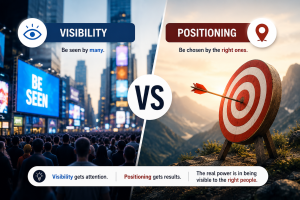
by, Manjima Madhu : Digital marketing executive cum video presenter , Levelup d studios
In today’s competitive digital landscape, brands are constantly trying to be seen. Content is being published daily, ads are being scaled, and social media presence is being expanded. As a result, visibility is often achieved.
However, a critical question remains—does being seen actually lead to being chosen?
This is where the distinction between visibility and positioning becomes essential. While visibility brings attention, positioning builds perception. In 2026, perception is what drives decisions.
Understanding Visibility in Marketing
Visibility refers to how often and how widely a brand is seen. It is typically achieved through social media activity, paid advertisements, SEO efforts, and content marketing.
Metrics such as impressions, reach, and views are commonly used to measure visibility. These numbers indicate how many people have encountered a brand. While visibility is important, it only represents exposure, not influence.
What Is Positioning?
Positioning is defined as how a brand is perceived in the minds of its audience. It answers key questions such as what the brand stands for, why it should be chosen over competitors, and what makes it different.
Positioning is built through consistent messaging, clear value propositions, and a strong brand identity. Unlike visibility, positioning is not about being everywhere. It is about being remembered for something specific.
The Core Difference: Attention vs Perception
The difference between visibility and positioning can be clearly understood. Visibility generates attention, while positioning shapes perception.
A brand may be seen frequently, but if it is not clearly positioned, it may be forgotten quickly. On the other hand, a well-positioned brand can be recognized and trusted even with limited exposure.
Why Visibility Alone Is Not Enough
It is often assumed that more visibility leads to more business. However, this is not always the case.
When visibility is not supported by strong positioning, audiences may not understand the brand’s value. Messaging may feel generic or inconsistent. Conversion rates may remain low, and marketing efforts may lose direction.
As a result, resources may be spent without generating meaningful returns.
The Power of Strong Positioning
When positioning is clearly defined, several advantages are created.
Differentiation is established, allowing the brand to stand out in a crowded market. Trust is built through consistent messaging. Decision-making is simplified because customers understand the value being offered. At the same time, marketing becomes more effective, as campaigns are aligned with a clear message.
How Visibility and Positioning Work Together
Although positioning is more impactful, visibility still plays a supporting role.
A strong marketing approach is built when positioning is clearly defined first, and visibility is used to amplify that positioning. Without visibility, positioning may go unnoticed. Without positioning, visibility may lack purpose.
Therefore, both elements must work together, but in the right order.
Building a Positioning-First Strategy
A shift towards positioning-first marketing can be achieved by defining a clear value proposition. The unique benefit offered by the brand should be communicated clearly.
In addition, the target audience should be understood in depth. Needs, challenges, and expectations must be analyzed. Consistent messaging should be maintained across all platforms. Instead of trying to appeal to everyone, a specific niche should be targeted.
Finally, visibility should be used strategically to reinforce positioning rather than dilute it.
Common Mistakes to Avoid
Several mistakes are frequently made when balancing visibility and positioning.
Frequency is often prioritized over clarity. Trends are followed without strategic alignment. Messaging is changed too often. Success is measured only through impressions.
These approaches can weaken brand identity and reduce long-term impact.
Visibility may attract attention, but positioning earns trust.
In 2026, brands that focus only on being seen may struggle to be remembered. On the other hand, brands that invest in strong positioning are more likely to build lasting connections and drive consistent growth.
The real question is not whether visibility matters, but whether it is being used to support a clear and compelling position.