
 Post by
By, Nandana GS , Digital Marketing Executive
In today’s digital ecosystem, a website is often considered the core of online presence. However, it has been observed that many businesses receive traffic but fail to convert visitors into leads or customers.
Therefore, the issue is not always visibility—it is conversion. When a website is not optimized for user experience and clarity, potential opportunities are lost.
What Is Website Conversion?
Website conversion is defined as the action taken by a visitor that aligns with business goals. This may include:
- Filling out a contact form
- Making a purchase
- Signing up for a service
- Requesting information
As a result, conversion is directly linked to business growth.
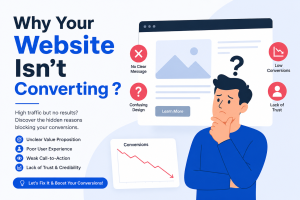
Why Websites Fail to Convert
1. Lack of Clear Messaging
When the value proposition is unclear, visitors may not understand what is being offered.
Consequently:
- Confusion increases
- Bounce rates rise
- Conversions decrease
2. Poor User Experience (UX)
Complex navigation and slow loading times can negatively impact user experience.
As a result:
- Visitors leave quickly
- Engagement is reduced
3. Weak Call-to-Action (CTA)
If CTAs are unclear or missing, users may not know what action to take.
Therefore:
- Opportunities are missed
- Conversion rates remain low
4. Lack of Trust Signals
Without credibility indicators, users may hesitate to take action.
This includes:
- Testimonials
- Reviews
- Certifications
Consequently, trust is not established.
5. Mobile Optimization Issues
With increasing mobile usage, websites must be responsive.
If not:
- User experience declines
- Conversions are affected
6. Overcomplicated Design
Visually heavy or cluttered designs can distract users from the main objective.
Therefore:
- Focus is lost
- Clarity is reduced
7. Slow Loading Speed
Delayed loading times can frustrate users and lead to drop-offs.
As a result:
- Bounce rates increase
- Engagement decreases
How to Improve Website Conversions
Step 1: Simplify Messaging
The value proposition should be clear and easy to understand.
Step 2: Improve User Experience
Navigation should be simple and intuitive.
Step 3: Use Strong CTAs
Clear and actionable CTAs should guide users effectively.
Step 4: Build Trust
Testimonials, case studies, and social proof should be included.
Step 5: Optimize for Mobile
Websites should perform seamlessly across devices.
Step 6: Enhance Page Speed
Loading times should be minimized to retain users.
Common Mistakes to Avoid
1. Focusing Only on Traffic
High traffic does not guarantee conversions.
2. Ignoring User Behavior
User interaction data should be analyzed regularly.
3. Lack of Testing
Continuous testing and optimization are required.
4. Overloading Information
Too much content can overwhelm users.
SEO Benefits of Conversion Optimization
- Improved user engagement
- Lower bounce rates
- Increased time on site
- Better search rankings
Consequently, both visibility and performance are enhanced.
A website should not only attract visitors but also convert them into customers. It has been proven that clarity, usability, and trust are key drivers of conversion.
Therefore, by optimizing these elements, businesses can transform their websites into powerful tools for growth.