
 Post by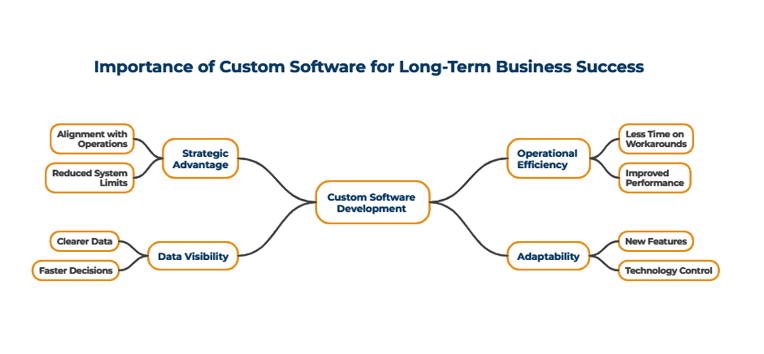
By Afla KC , Digital marketing executive
Introduction
In today’s fast-paced digital economy, businesses are constantly searching for ways to improve productivity, reduce operational costs, and stay ahead of the competition. While many organisations rely on off-the-shelf software to manage daily operations, these generic solutions often fall short when it comes to addressing unique business needs. Every company has its own workflows, challenges, goals, and customer expectations, making a one-size-fits-all approach less effective over time.
This is where custom software comes into play.
Custom software is specifically designed to meet the unique requirements of a business. Instead of adapting your processes to fit standard software, custom solutions are built around the way your organization operates. Whether it’s automating repetitive tasks, integrating multiple systems, managing customer relationships, or improving internal collaboration, custom software helps businesses work smarter, faster, and more efficiently.
As digital transformation accelerates across industries, investing in custom software has become a strategic decision rather than just a technological upgrade. Businesses that adopt tailored software solutions gain greater flexibility, better scalability, enhanced security, and a significant competitive advantage.
In this guide, we’ll explore how custom software improves business efficiency, its key benefits, real-world applications, implementation challenges, and why it’s becoming an essential investment for modern organizations.
What Is Custom Software?
Custom software is an application developed specifically for a business or organization to address its unique operational requirements. Unlike commercially available software designed for a broad audience, custom software is tailored to support specific workflows, business processes, and objectives.
Examples of custom software include:
- Customer Relationship Management (CRM) systems
- Enterprise Resource Planning (ERP) platforms
- Inventory management systems
- Appointment booking platforms
- Human Resource Management Systems (HRMS)
- Learning Management Systems (LMS)
- Mobile applications
- Customer portals
- Workflow automation platforms
Because it is designed around the business rather than the other way around, custom software provides greater efficiency and long-term value.
Why Businesses Need Custom Software
Many businesses begin with off-the-shelf software because it’s quick to deploy and relatively affordable. However, as operations grow, these tools often reveal limitations.
Common challenges include:
- Features you don’t need
- Missing functionality that your business requires
- Limited customization options
- Poor integration with existing systems
- Increasing licensing costs
- Scalability issues
Custom software eliminates these challenges by delivering exactly the features and functionality your organization needs.
How Custom Software Improves Business Efficiency
1. Automates Repetitive Tasks
One of the biggest advantages of custom software is automation.
Many businesses spend hours every week performing repetitive tasks such as:
- Data entry
- Invoice generation
- Inventory updates
- Employee attendance tracking
- Report creation
- Appointment scheduling
Custom software automates these activities, reducing manual effort and minimizing human error.
Employees can focus on strategic work instead of routine administrative tasks.
2. Streamlines Business Processes
Every business has unique workflows.
Off-the-shelf software often forces companies to change their processes to match the software’s capabilities.
Custom software works the opposite way—it is designed around existing workflows.
This creates:
- Faster operations
- Fewer bottlenecks
- Improved collaboration
- Better process consistency
As a result, businesses operate more efficiently.
3. Improves Employee Productivity
When employees have software designed specifically for their responsibilities, they can complete tasks more quickly and with greater accuracy.
Instead of switching between multiple applications, custom software centralizes business operations into a single platform.
This reduces confusion while increasing overall productivity.
4. Enhances Customer Experience
Customer expectations continue to rise.
Custom software enables businesses to provide:
- Faster service
- Personalized experiences
- Online self-service portals
- Real-time updates
- Secure customer accounts
- Automated communication
Satisfied customers are more likely to remain loyal and recommend the business to others.
5. Integrates Multiple Business Systems
Many organizations use separate tools for accounting, customer management, inventory, marketing, and communication.
Managing disconnected systems often creates duplicate work and inconsistent data.
Custom software integrates these systems into a unified platform, allowing information to flow seamlessly across departments.
This improves collaboration and reduces operational complexity.
6. Provides Real-Time Data and Reporting
Business decisions should be based on accurate information rather than assumptions.
Custom software provides real-time dashboards and reports that allow managers to monitor:
- Sales performance
- Inventory levels
- Employee productivity
- Customer activity
- Financial performance
- Operational efficiency
Access to real-time insights supports faster and better decision-making.
7. Supports Business Growth
As businesses expand, their operational requirements evolve.
Custom software is designed with scalability in mind.
New features, departments, users, and integrations can be added as the organization grows without replacing the entire system.
This protects long-term technology investments.
8. Strengthens Data Security
Protecting sensitive business and customer information is a growing priority.
Custom software offers greater control over security measures, including:
- User access permissions
- Multi-factor authentication
- Data encryption
- Secure backups
- Audit logs
- Compliance with industry regulations
Unlike generic software, security features can be tailored to the organization’s specific needs.
Key Benefits of Custom Software
Increased Efficiency
Automation and streamlined workflows reduce unnecessary manual work.
Lower Long-Term Costs
Although initial development may require a larger investment, businesses avoid recurring licensing fees and expensive feature upgrades.
Better Flexibility
Custom software evolves alongside business requirements without unnecessary limitations.
Competitive Advantage
Unique software capabilities help businesses differentiate themselves from competitors.
Improved Accuracy
Automation reduces human error while ensuring consistent business processes.
Better Collaboration
Employees access shared information from one centralized platform, improving communication across teams.
Industries That Benefit from Custom Software
Healthcare
Custom healthcare software supports:
- Patient management
- Appointment scheduling
- Electronic medical records
- Billing systems
- Telemedicine platforms
Retail
Retail businesses use custom software for:
- Inventory management
- Customer loyalty programs
- Online ordering
- Point-of-sale systems
- Sales analytics
Education
Educational institutions benefit from:
- Student information systems
- Online learning platforms
- Attendance management
- Examination portals
Manufacturing
Manufacturers use custom software to improve:
- Production planning
- Inventory control
- Equipment monitoring
- Supply chain management
- Quality assurance
Logistics
Logistics companies optimize:
- Fleet management
- Route planning
- Shipment tracking
- Warehouse operations
Challenges of Developing Custom Software
While custom software offers many advantages, businesses should consider several factors before starting development.
Initial Investment
Custom software typically requires a higher upfront cost than purchasing standard software.
However, long-term savings often outweigh the initial expense.
Development Time
Building software from scratch requires planning, design, testing, and implementation.
Businesses should establish realistic timelines.
Ongoing Maintenance
Software requires regular updates, security improvements, and feature enhancements to remain effective.
Choosing the Right Development Partner
Selecting an experienced software development company is critical to project success.
A reliable partner understands business goals, industry requirements, and future scalability.
Best Practices for Successful Custom Software Development
Businesses can maximize the value of custom software by following these best practices:
Clearly Define Business Objectives
Understand the problems you want the software to solve before development begins.
Involve End Users
Gather feedback from employees who will use the system daily.
Prioritize User Experience
Simple, intuitive interfaces encourage adoption and improve productivity.
Focus on Scalability
Build software that can grow alongside the business.
Test Thoroughly
Comprehensive testing ensures reliability, security, and performance before deployment.
Monitor Performance
Regular updates and continuous improvements keep the software aligned with changing business needs.
The Future of Custom Software
Emerging technologies continue to shape software development.
Future custom software solutions
will increasingly integrate:
- Artificial Intelligence (AI)
- Machine Learning
- Predictive Analytics
- Internet of Things (IoT)
- Cloud Computing
- Robotic Process Automation (RPA)
- Advanced Cybersecurity
- Low-Code and No-Code Integrations
These innovations will make custom software even more intelligent, automated, and adaptable.
Conclusion
Custom software has become a powerful driver of business efficiency, enabling organizations to automate processes, improve productivity, enhance customer experiences, and make smarter decisions through real-time data. Unlike off-the-shelf solutions, custom applications are built around a company’s unique workflows, allowing businesses to operate more effectively without compromising on flexibility or scalability.
While developing custom software requires careful planning and an initial investment, the long-term benefits often far outweigh the costs. Businesses gain greater control over their operations, stronger security, seamless system integration, and the ability to adapt quickly as their needs evolve.
As digital transformation continues to reshape industries, investing in custom software is no longer just a technology upgrade—it’s a strategic move toward sustainable growth and operational excellence. Organizations that embrace tailored digital solutions today will be better equipped to innovate, compete, and thrive in the rapidly changing business landscape.